If you are deciding to travel to eastern Africa and want a fun semi-technical adventure, you can't miss the chance at standing at the top of Africa. At 19,320 feet, you will get the best view on the continent, test your limits, travel through four climate zones, can cross off one of the seven highest summits of the seven continents, and have an amazing experience you will never forget. Kili is the highest free standing mountain in the world, and climbing it you get that sense that you are standing on top of the world.
There are six main routes that you can choose to take to the summit. Lemosho, Machame, Rongai, Umbwe, Mweka, and Marangu.

The Marangu route is the route I picked. It is nicknamed the Coca Cola Route because it's the route most tourists take. It also allows you the comfort of sleeping in huts rather than tents. While I like a challenge, I decided to do the most common route because it was the cheapest and the fastest way up the mountain. I had 7 days before I had to catch a flight in Nairobi, so I took a chicken bus from Kenya, down to Arusha Tanzania, and began my 70 km round trip to the top of Africa.
While the hike isn't very challenging the altitude still claims many victims, so an inexperienced hiker has to respect the mountain. As you climb up the trail you are reminded about the dangers and altitude ahead, as other hikers are being rushed down the trail because of medical issues by a cart.
It was always intimidating reaching a hut and talking to other climbers on the way down who were wacked out by altitude sickness. One hiker kept repeating how confused he was, and told us how emotional he got hiking. He made it to the top, but cried the whole way. So remember to "Poli Poli" as my guide always yelled to me, which in Swahili means slowly slowy.
 My Guide Ashard.
Day One, started out about 2 p.m. It can become frustrating waiting for your permit to go through, at the park entrance. Once you get to begin your hike, you start off in the forest making your way up beautiful lush terrain. Keep your eye out for monkeys. First day takes about 5 hours to reach the first hut.


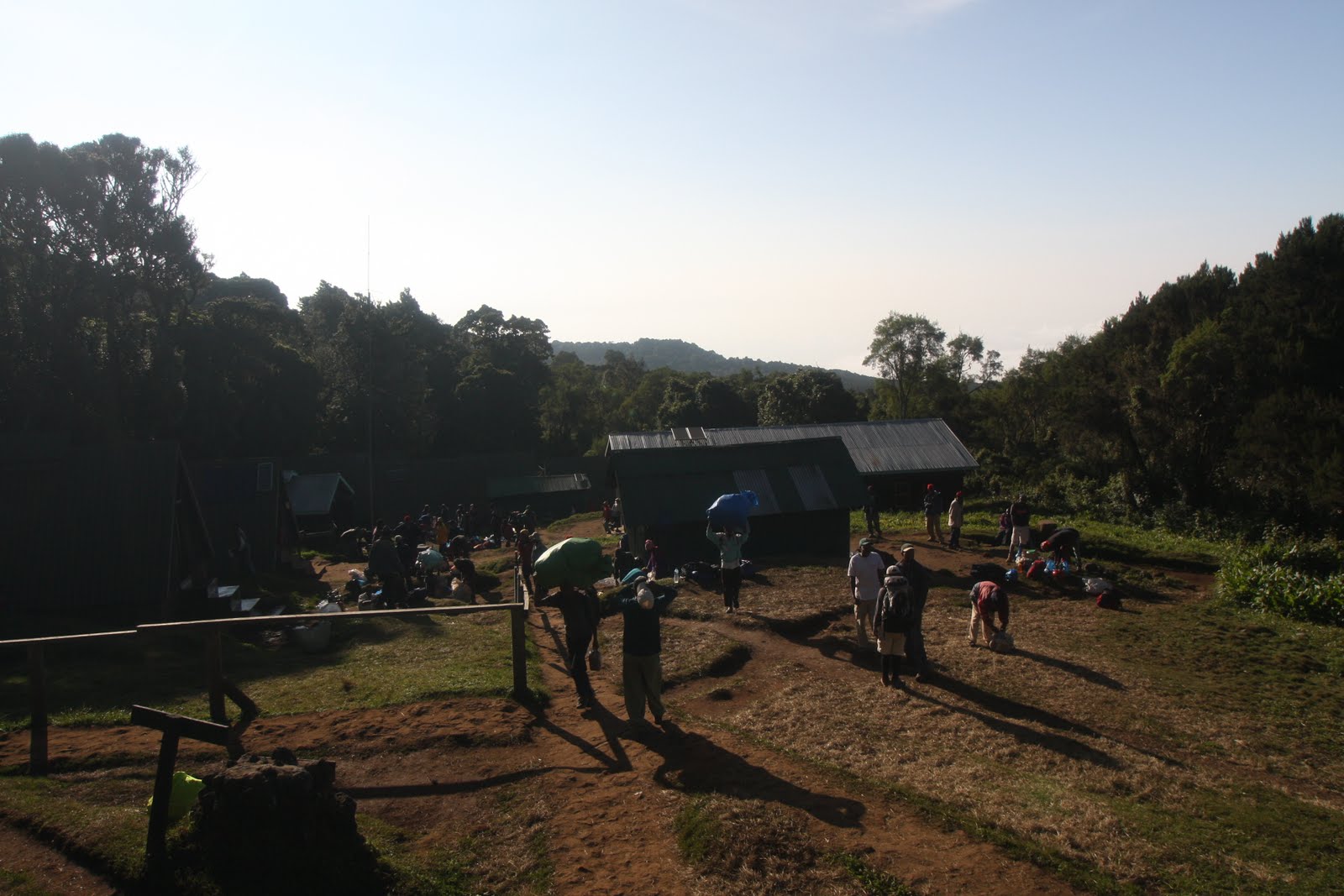 Mandara Hut. First Hut on Marangu route. After arriving and checking in. Go explore the area with a short hike.
 End of day one.
 Day two begins with more hiking through the forest but the forest begins to disappear. The trees get smaller and smaller.
 As you climb higher, you leave the forests behind and enter the Moorland Zone.
 If its clear, this is the first time you get to spot the top of Kili and it's snow capped peak. Your goal is finally in sight.
 The porters are as tough as they come. Some walk bare foot, others in slippers like this older man. I was embarrassed to have older men have to carry my bag. But it creates jobs which the people desperately need.
 Kilimanjaro has some unique vegetation that can be seen nowhere else.
 My guide taking a break.
Day 2 took us to Horombo Hut. The tip of Uhuru Peak starts getting bigger and and bigger, inspiring you to push on. You will know by this point if your body can handle high elevation.
 Day two came to an end with an Amazing Sunset above the clouds.
 This smile greeted us every morning to let us know our breakfast was ready.
 The beginning of the third day you can start feeling the altitude. You are now above 11,000 feet. A clear day gives you an amazing view of the crater.
 After a few refreshing Kilimanjaro Beers, I began my third day. They don't sell alcohol on the mountain because it makes you dehydrated and isn't good for your body trying to adapt to the lack of oxygen. But I couldn't miss the opportunity to drink a Kili beer on Mt.Kilimanjaro.
 Dinning hall at Horombo Hut, with Mawenze Peak behind
 My bad ass hiking partner who was paired with me. She was a school teacher from NY. I was impressed by her toughness. She got a nasty blister on the first day of the hike yet managed to keep pushing on and made it to the top with me.
 Day three takes you to the third Climate Zone, by leaving behind vegetation and entering the alpine desert.
 Not sure if the picture on the beer can was selected from this location, but it looked similar.
 At about the 12,000 t0 15,000 foot level, you feel like you are hiking across the surface of Mars. Excellent views of Mawenzi in the background, the other peak of Kilimanjaro.
Most climbers stop at Kibo Hut for a rest before continuing on early the next morning. We decided not to stop and pushed on to the summit. We wanted to leave the crowds behind.
 Trail leading to base of Uhuru Peak. Kibo Hut awaits you at the bottom.
 Beginning the hardest part of the climb. At 15,000 ft you start to head up a steep incline, up the last four thousand feet to the crater rim.
 Caves give you good places to rest, while trying to summit.
 Views on the way up are amazing. Above the 17,000 foot mark. Mawenzi peak seen on the right.
 View as you reach the rim of the crater, and enter the snow cap zone. The temperatures drop to below freezing as snow and ice covers most of the ground. My water bottle completely froze solid.
Congratulations you reached Gilman's Point. You are at the top of the rim but not yet at the highest point. Some climbers turn back at this point, receiving a silver certificate for reaching the top. But just suck it up and continue another 1-2 hours around the crater rim and you will be at the highest point. There you will receive a gold certificate and have the bragging rights that you conquered Mt. Kilimanjaro.
 View from rim.
 View of glacier on north side, as we continued past Gilman's Point. You can see the sign on the right.
 Continuing up the crater rim, racing the setting sun, you get amazing views of the glacier on the west side and the African landscape. The number one reason to hike Kili, was to see the glacier at the top before it melted. I wanted to photograph the glacier up close, but lost to the setting sun. I wish I could have camped at the top because the views are spectacular. Was lucky and didn't have any problems with the altitude.
 My guide and I at the top of Uhuru Peak. It took me 2 1/2 days to summit.
Wanted to reach the top for sunset, but my guide set a snails pace up the rim. I decided to summit at night on the third day and avoided the big crowds who summit during the morning. We had the entire top of the crater to ourselves. Most hikers wake up early in the morning, to attempt to summit, but that means you could wait in line for 30 min to get your picture with the sign, because of the crowd of hikers all following the same game plan.
 Since we had the top to our self, we hung out at the sign for a bit longer than normal. Allowing me to be my usual poser self. It wasn't my first choice, but my guides refusing to take my pic naked and the cold temperatures made plan A a bad idea.