
This blog follows my travel photography and the experiences I capture with and without my camera. The ups and downs, the exhaustion, the danger, and the euphoria that goes along with each journey. Beyond Adventure Photography and Blog is about more than just the adventure of traveling. It's about pushing ones self to the very edge, living life to the fullest, discovering amazing places, opening your mind to new cultures, and most importantly, discovering what makes you happy in life.
Friday, October 7, 2011

Trophy Hunting. Photographing the World's Biggest Moose

Photos of large moose and other Alaskan Animals
I slowly stalk my way through the tall willows, trying not to get my backpack and camera equipment entangled in the jungle like mix of bushes and swamp. A low mist hovers above the ground like a scene in a horror movie, hiding a monster that I am hunting. The temperature is around freezing, making my breath look like smoke, and blankets the willows with a layer of frost that soaks my clothing.
The willows tower over my 6'5 frame, making it seem as if I'm walking through an endless maze. Everything you are taught about hiking in Alaska, I am ignoring. I'm walking through tall vegetation, not making any noise, hiking alone, and not caring a gun or bear spray.
But I am relying on my many years of experience hiking in the back country, to keep me safe. While encountering a bear in this dense vegetation could turn deadly, the reward of getting up close to this trophy is well worth the danger.
Photographing these amazing animals is an experience I look forward to every fall. I'm not here to shot and kill these animals. Rather I'm a trophy hunter, with a camera. Who would rather shoot these studs, with a camera instead of a gun. To hang a photograph of them on my wall, to me is more rewarding than a moose head.

Alces alces or more commonly known as the "Moose," stands 7-8 feet tall at the shoulders, weighs up to 1600 pounds, and have antlers that grow up to 84 inches wide.
There are seven subspecies of Moose.
Alaskan moose: is the largest subspecies of moose and largest member of the deer family in the world. Found in Alaska and west Yukon, Canada.
Eurasian Elk: Found in Finland, Sweden Norway, Russia.
Eastern Moose: Eastern Canada, including Ontario, Quebec. Northeastern United States, including states Maine, New Hampshire, Vermot, New York, Connecticut, Rhode Island, and Massachusetts.
Western Moose: Western Canada, eastern Yukon, Northwest Territories. Northern United States, Wisconsin, Minnesota, and North Dakota.
Siberian Moose: Eastern Siberia, Mongolia, Manchuria. No longer found in China and the Koreas.
Shiras Moose: Wyoming, Idaho, Utah, Colorado. Washington. oregon, and Montana. Smallest of the moose subspecies.
Caucasian Moose: Extinct dur to habitat loss and overhunting. Lived in Iran, Russia, Georgia, Azerbaijan, and Turkey.
Standing face to face with an Alaskan bull moose is like standing in front of a Clydesdale horse. But this animal isn't pulling a wagon full of beer. There is no Anheuser-Busch, but rather a wild animal with a bad temper and two satellite dish sized weapons attached to his head. No other member of the deer family can rival the size and strength of the moose.
 Like fingerprints, every bull moose has his own unique set of antlers. This huge bull had a really interesting set.
When bull moose loose their velvet, they are easy to spot across valleys. Their antlers stand out like two white flags. Not good for them during hunting season.
 Average bull moose walking down a small valley. Lone bulls who loose fights with more dominant bulls, have to look forward to the future, when they are big enough to win battles.
  Getting between a bull and his cow's can turn into a dangerous situation. Moose can run 40 miles per hour and have a kick that can kill a brown bear.
Interesting Fact: If a bull moose is castrated, either by accident or other means, he will shed his antlers quickly and start growing a new set of deformed antlers. He will never shed these antlers for the rest of his life. Native Indians used to call them, "devil's antlers."


In the fall Moose gather in what is called the rut. Big bulls battle each other for the right to mate with the females or cows. Moose are generally solitary animals, besides mother and calf, and during the rutting season, where moose will gather looking for mates. This big male must be popular among the ladies.
Photos of large moose and other Alaskan Animals
Sunday, August 14, 2011
Brooks Falls

As I start into the woods, and head down the narrow path towards Brooks River, I scan the woods for movement. The trees are thick, and the forest is dark, but it's easy to see deep into the forest, because of the lack of undergrowth. There have been many times that I have walked this path and have come face to face with a huge Alaskan bear or two running down the trail. This time, I'm not that lucky.
Even before I get close to the falls, I start hearing the deep roars of some of the biggest bears on the planet, fighting for prime fishing spots. Any other time or place and the sound would send chills down your spine, and you heading quickly in the opposite direction. The sound is pretty intimidating.
This stretch is one of the most exciting places to walk, since bears are always coming and going from the falls. At any moment you can run into a bear. I've been walking along this stretch, behind a girl all dressed up. She flew to the falls for just a day trip.
Out of nowhere a smaller bear came running down the trail at full speed with a salmon in his mouth, followed by a much bigger bear. She froze right in the trail and wouldn't move, lucky the bears ran right around her and didn't just plow her down like bulldozers. It was her first experience seeing a bear. The look on her face was priceless.
Once you reach the falls. You can choose two platforms to photograph fishing bears. A lower one gives you a view of Brooks River and the falls from a distance. The second, and more popular, is directly next to the falls and allows people to watch the action close up
The falls platform, is an amazing place to photograph brown bears. It is one of those unique places around the world, that leaves you with an experience that you will never forget. When the fish are running you can see up to 25 brown bears at the falls, fighting over the best fishing holes.
While the big males fight down below using their size to intimidate others, there is a battle on the platform between photographers.
Tourists with small point and shoot cameras, often move out of the way for photographers with huge 800 mm lenses and thousand dollar cameras. It's funny to watch.
If you decide to visit Brooks Falls, spend sometime getting to know the bears. Each has a distinct personality, and each has earned his spot at the falls. Each scare on their back tells the story of a battle won or lost. After a few days you turn into a spectator, and cheer on your favorite bear. My favorite is Oatis who I've photographed two years now fishing below the falls.

Oatis, a large male can always be found underneath the falls. He was named after a dog because he stands still and just stares at the falls like a dog waiting for a ball to be thrown to him. When the fish are thick he catches a lot of them.
Gangus, is a huge male who has fought for the right to sit in the "jacuzzi" and let the fish come to him. He looks like an old man relaxing in a jacuzzi, since only his head is out of the water.
Cinnamon is one of the oldest bears ever in the history of Katmai National Park. If he returns to the falls next year, he will be 31. Male brown bears rarely live into their late 20's. He was looking very old this year. Bones showing through his skin. But he looked like that last year and survived the winter.
 Cinnamin in 2011 watching the action next to the falls. He used to be one of the dominant males, but his age has kept him from being able to compete with younger stronger males. If he returns next summer he will be the oldest bear in the history of Katmai. He is 30 years old.
 People think animals don't have compassion. The bigger males could easily chase away or kill cinnamon. But they tolerate him as if showing respect to their elders. I even saw bears allow cinnamon to eat fish caught at the falls.
 This bear is a famous bear. He has learned to catch fish from the falls, and is in a lot of famous photographs about Brooks Falls.
 Bear using a tree as an itching post. This bear's nose is probably ten feet high.
 This male and female had been mating, so when they walk down the road towards the falls, you make sure to get out of their way.

Nice Catch!
 Flo and her 2 year old cubs. They were nick named the "terrible two's" They were famous for using their numbers to their advantage and bully other bears out of their fish.
 Does a bear sleep in the woods?
 Visitors on the platform. Oatis is focused on the falls. And Gangus is relaxing in the Jacuzzi.
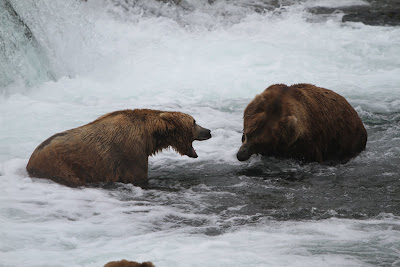 "hey this is my fishing hole, buddy, move it."
 Bear walking along Naknek Lake

 Cinnamin in 2011 watching the action next to the falls. He used to be one of the dominant males, but his age has kept him from being able to compete with younger stronger males. If he returns next summer he will be the oldest bear in the history of Katmai. He is 30 years old.
 People think animals don't have compassion. The bigger males could easily chase away or kill cinnamon. But they tolerate him as if showing respect to their elders. I even saw bears allow cinnamon to eat fish caught at the falls.
 This bear is a famous bear. He has learned to catch fish from the falls, and is in a lot of famous photographs about Brooks Falls.
  Bear using a tree as an itching post. This bear's nose is probably ten feet high.
  This male and female had been mating, so when they walk down the road towards the falls, you make sure to get out of their way.
Nice Catch!
 Flo and her 2 year old cubs. They were nick named the "terrible two's" They were famous for using their numbers to their advantage and bully other bears out of their fish.
 Does a bear sleep in the woods?
 Visitors on the platform. Oatis is focused on the falls. And Gangus is relaxing in the Jacuzzi.
  "hey this is my fishing hole, buddy, move it."
 Bear walking along Naknek Lake
Wednesday, August 3, 2011
Valley of Ten Thousand Smokes

Link to more photos of Valley on my photography website.

A brown bear makes his way along the river bank, stopping to eat grasses and roots. He looks forward to the first salmon making their way upriver.
A giant moose is grazing on the green shoots sprouting up, where the winter snow has melted. A wolf, trots up the valley looking to catch a ground squirrel off guard, before he sends out a warning to others and they all run into their burrow. A beaver swims across one of the many kettle ponds, with a newly chewed stick to add to his grand lodge.
At the base of a valley, a village of Alaska Natives, prepare for the abundance of the upcoming sockeye salmon run. The June day is peaceful and quiet.
Deep below the ground, the magma begins to push upwards towards the surface. Pressure builds like a shaken carbonated soda, straining the already fractured earth's crust. The earth begins to shake as the magma rumbles inside the chamber.
When the shaking stops, the villagers at the base of the valley, go about their business as before. But a worried look grows on the elders. The spirits in the mountains have been very angry lately and the increase in the earth trembling, makes them sense there might be danger looming.
Growing up, their elders used to tell them about stories passed down through generations, about such events in the past, that brought pain and suffering to their people. Events that shook the earth, turned day into night, and rained hot earth from the sky. A leader of the village decides to hike up a nearby mountain, to see if he can spot any danger.
Hours later, as he makes his way up the steepest part of the mountain the shaking begins again. Looking up the valley, Mt. Katmai's snow capped peak is visible in the distance, much larger than the rest. Then there is an explosion so massive and loud, that it knocks him to the ground. The dazed man, gets to his feet with ringing in his ear drums, similar to having an artillery shell explode near him. His mind races as he is one of the only few witnesses to one of the largest eruption in recorded history.
He races down from his outlook and back to his village to warn the others. In the distance, the ash raises into the sky, another blast sends an avalanche of molten earth racing down the valley at hundreds of mile per hour.
The warned villagers runs, to the lakeside, jump into their man made boats and kayaks, and paddle as fast as they can, out into Lliuk Arm, towards the larger Naknek Lake. Just as their ancestors had done before, they abandon their village all together.
They don't have much time, because a pyroclastic flow, 30 times bigger than the eruption at Mt.Saint Helen's, is on it's way, flash boiling the kettle ponds, lakes, knocking down every tree in it's path like some nuclear blast, and even damaging surrounding mountains.
Jump four years to 1916, a group of explorers are walking their way up a valley that looks nothing like before. Steam is rising all around them, chunks of mountain crash down towards the valley floor, what was once a lush valley, is now blanketed with ash, 700 feet thick.
Sent by the National Geographic society, they are exploring and studying the aftermath of one of the biggest eruptions in history. They are late studying the eruption, since the world was distracted by the more popular event of the sinking of the Titanic in 1912. But, even four years later the place is still an inferno.
Robert Griggs, leader of the expedition into the valley, writes about his experience with a famous quote.
"The valley as far as the eye could reach, was full of hundreds, no thousands, literally ten thousands of smokes curling up from its fissured floor. It was as though all the steam engines of the world, assembled together, had popped their safety valves at once and were letting off steam in concert."
At first they think Mt. Katmai is the cause of the eruption, since only a crater is left where a mountain once stood. But they later discover a new crater, Novarupta, and it's lava dome, formed, where 3 cubic miles of mountain once stood. The surrounding mountains are baked and damaged, sections still crumble and fall, one being named falling mountain, the other broken mountain.
Jump a head almost a century, and I'm exploring the valley for the first time. Alone, I walk up the valley and am blown away by what I see. The isolation of the place means I don't come across another soul. The valley has cooled, Novarupta is sleeping, and only a few of the ten thousands of smokes remain at the head of the valley, but it still looks as if I am walking across a new eruption. Not much vegetation has grown, but the rivers have carved deep canyons in the deep ash, making it near impossible to cross the valley.

I feel like I'm walking across the surface of Mars. Polychrome ash, pumice, and dark volcanic rock is scattered across a flat landscape. You could describe it as hell's kingdom, a unforgiving place, with very little life. Strong winds can shred your tent, and blow ash into your eyes, rains and melting glaciers rise surrounding creeks quickly, and make them hard to cross. Isolation means you must be prepared to save yourself.


At the epicenter of the devastated landscape, lies Novarupta Dome. A beaver lodge looking, pile of fractured lava that had ouzed out of the crater and still steams, like smoke coming out of the chimney of the devil's castle.
Novarupta erupted in june of 1912, displacing 3 cublic miles of earth. Compare that with .1 cubic miles that happend with Mt. St.Helens. or 2 cublic Miles that Happened with Krakatoa and Vesuvius, and you can sense how big this eruption was. The importance of the eruption helped protect the surround land and create Katmai National Park.
The eruption was so loud that it was heard in Juneau, the equvilant distance between Chicago and New York City. The eruption sent so much ash into the atmosphere that it cooled the earths temperature by one degree, dusted Seattle, tarnished brass in california, and choked the air, on the Island of Kodiak, 90 miles away, that locals couldn't see lanterns, in their out reached hands.

Link to more photos of Valley on my photography website.

Today a tour bus takes visitors from Brooks Lodge, back to the base of the valley and stops at a visitor center that looks out over the Valley of Ten thousand Smokes. An optional guided hike by a park ranger, takes you on a three mile round trip, hike down into the valley and along side the ash flow. You can stand upclose and admire how much destruction the massive pyroclasic flow, created.
Those more adventurous can be dropped off and can hike back into the valley, allowing you to get an upclose sense of the size and magnitude of the eruption. Be prepared, because the Isolation means you better bring relable camping equipment.
The reward is experiencing a landscape that few have ever seen and is very photogenic in it's appearance. Active volcanos surround you as you traverse the head of the valley and gaze at the steaming mother of all volcano's. Hopefully you are nowhere close, when she desides to wake up.
Link to more photos of Valley on my photography website.
Wednesday, July 13, 2011
Take a Cement Tablet.. And Harden the Fuck Up
It's 10 P.M, the storm is feeding off the low pressure in the Bering Sea, like a starving beast. A big bad wolf is huffing and puffing, and preparing to blow your boat down.
Even in a protected bay, the waves try to get at us little piggies, in small but choppy, white caps, like tentacles, rocking your anchored boat, back and fourth like a cork in a bath tub.
The land and sky are alive, the clouds are elongated, like they have been stretched and pulled, by a giant. It's a classic Bering Sea night.
For now, I am inside our boat, warm,waiting for the fishing opener in a few hours, looking out the window at the scene upfolding. Everyone aboard, is paying attention to the recorded weather updating over the radio, telling you how bad it will be. A girls, recorded voice talks about the weather. "Today, gail force winds, blowing from the west, seas 10-14 feet, small craft warning till tomorrow night."
It's one hour till the opener, you pull up the anchor, and head out of the bay and into the mouth of the beast. Heading around the protective spit, the waves start to grow, and grow and grow, like monsters. Your boat begins climbing and and descending 10-14 foot swells, making your 32 foot boat seem small, and insignificant. Each weld in your aluminum boat, will be tested tonight.
As a deck hand your spot is at the stern of the boat. So you put on your armour,"rain gear, and head into battle. The wind is howling, stinging your cheeks, the rain prickling your eyes, like needles. You are forced to keep your head down, as spray from breaking waves, crashes against the bow and washes up and over the back, and down on you, like your in a car wash. Your sea legs keep you steady, as you ride the waves like a cowboy.
This year's storm would test us, since we had three 17 foot waves crash into our boat and threaten to swamp us. One completely blind sided me, like I was a quarterback being tackled by a defensive linemen.
Bristol Bay, is famous for it's narly waves, that create freaks that don't follow the laws of physics. Shallow waters, and sand bars break up the huge swells, causing them to divide like an advancing army, and head in all different directions,flanking and richicheting of eachother, then bouncing back like some tag team wrestling match where three come to clothes line you at one time. Others, seem more animal like, take you head on, like a bull, then rise up like a king cobra's hood, growing higher and higher, till they look into your eyes and stare down your soul. Most wouldn't dare to venture out in this storm, but for fisherman who have four weeks to make a living, you can't afford to take the opener off, not when the fish are running.
While friends and family are home in their warm beds, having a restful sleep, dreaming about wonderful thoughts, a Bering Sea fisherman is a warrior heading into hell. They accept the dangers, the risks, and paying the ultimate price. Those that didn't accept this, that are scared,and not sure if they can handle the Bering Sea, "need to take some cement tablets and harden the fuck up."
Even in a protected bay, the waves try to get at us little piggies, in small but choppy, white caps, like tentacles, rocking your anchored boat, back and fourth like a cork in a bath tub.
The land and sky are alive, the clouds are elongated, like they have been stretched and pulled, by a giant. It's a classic Bering Sea night.
For now, I am inside our boat, warm,waiting for the fishing opener in a few hours, looking out the window at the scene upfolding. Everyone aboard, is paying attention to the recorded weather updating over the radio, telling you how bad it will be. A girls, recorded voice talks about the weather. "Today, gail force winds, blowing from the west, seas 10-14 feet, small craft warning till tomorrow night."
It's one hour till the opener, you pull up the anchor, and head out of the bay and into the mouth of the beast. Heading around the protective spit, the waves start to grow, and grow and grow, like monsters. Your boat begins climbing and and descending 10-14 foot swells, making your 32 foot boat seem small, and insignificant. Each weld in your aluminum boat, will be tested tonight.
As a deck hand your spot is at the stern of the boat. So you put on your armour,"rain gear, and head into battle. The wind is howling, stinging your cheeks, the rain prickling your eyes, like needles. You are forced to keep your head down, as spray from breaking waves, crashes against the bow and washes up and over the back, and down on you, like your in a car wash. Your sea legs keep you steady, as you ride the waves like a cowboy.
This year's storm would test us, since we had three 17 foot waves crash into our boat and threaten to swamp us. One completely blind sided me, like I was a quarterback being tackled by a defensive linemen.
Bristol Bay, is famous for it's narly waves, that create freaks that don't follow the laws of physics. Shallow waters, and sand bars break up the huge swells, causing them to divide like an advancing army, and head in all different directions,flanking and richicheting of eachother, then bouncing back like some tag team wrestling match where three come to clothes line you at one time. Others, seem more animal like, take you head on, like a bull, then rise up like a king cobra's hood, growing higher and higher, till they look into your eyes and stare down your soul. Most wouldn't dare to venture out in this storm, but for fisherman who have four weeks to make a living, you can't afford to take the opener off, not when the fish are running.
While friends and family are home in their warm beds, having a restful sleep, dreaming about wonderful thoughts, a Bering Sea fisherman is a warrior heading into hell. They accept the dangers, the risks, and paying the ultimate price. Those that didn't accept this, that are scared,and not sure if they can handle the Bering Sea, "need to take some cement tablets and harden the fuck up."
Ebb and Flood of Life

At the moment I'm anchored up in Egegik Bay, where freshwater from Bacherof Lake on the Alaska Penisula, travels down the Egegik River and meets the Bering Sea.
It's June 18th, and nearly midnight, yet there is still daylight. A gift being so far north, is the days seem to last forever. But when you are sitting on an anchored boat, with not much room and nothing to do, and all the time in the world to wait, the gift of endless dull days, is like opening the same present over and over and over and over. Even the clock seems to tick backwards.
It's crappy out, fog hangs low in the air, the sky and land is a dull colorless canvas. Nothing stimulating for the senses, other than watching the ocean drain from around you, in the out going ebb. Even the seals that are hauled out on the sand bar, seem bored.

To break up the boredom, you find yourself reading through books like your about to compete in a battle of the books competition. At the moment I'm reading a book called Discarded Science, "Ideas that seemed good at the time." It's full of wacky theories man once had that now looks pretty ignorant.
Take the idea that Jupiter was full of hemp. "Jupiter had four moons rather than one, this must mean there were a lot of seafarers there. Hence a lot of Boats. Hence a lot of sails- hence a lot of ropes with which to pull the sails up and down. And.... to make a lot of ropes, you need a lot of hemp."
I tell this to my other deck hand, who is scanning through a stack of playboy magazines, and "not" reading the articles. He responds, "good, then we aren't the only bored and sexually deprived fishermen in this galaxy."
It's not always dull out in the Bering Sea. Last night the sun set, over the crystal clear sky and dunked into the Bering Sea with a green splash. An atmospheric phenomenon, I had never seen before, and wish I had captured with my camera. Tonight, is the flip side, it's as if the world is hidden behind a filter, blocking out any color.
We aren't fishing yet, since it's still early in the season,the huge run of salmon is absent, still swimming their long journey home. So we have nothing to do but wait, and let our anticipation for the upcoming season eat on us, like 9 year olds the night before Christmas.

In the coming days or weeks, the salmon will hopefully arrive in the millions, in the incoming tide. All run on an inate biological clock, that reminds them that their life in the ocean is over and it's time to return to the fresh water.
When the salmon arrive you no longer have time to do anything but work. The sleep bandits, arrive and for the next five weeks they steal your life. "A rising tide not only lifts all boats," it fills fisherman's nets.
All the boats anchored and lifeless at the moment, like we are, will be fighting for room to set out their nets, running their gear, and workin the district lines as hard as they can, 24 hours a day 7 days a week. Through huge storms, and freezing cold weather. Around July 4th, we not only celebrate Independence Day, we are in the climax of the run which ususally lasts for the next 2 weeks.
Commercial fishinig in Bristol Bay is more like destruction derby for cars. You have to fight for everything you catch, it's actually really entertaining to watch and will probably have a reality show about it someday as well. Boats ram into eachother, set nets over eachothers nets, and get nets and line wrapped up in their propellers.
At the end of the season, life slows down again as fisherman head back to port and home to their normal lives. Some will have a great season and some will have a shitty season. But since we aren't fishing at the moment our lives slow, slow, slow, down to the natural rhythm of the ocean. That's the ebb and flood of life.
Subscribe to:
Posts (Atom)